HTTP and SMPP Configuration Changes for A2P SMS: Deployment and Rollback
An operational guide to identifying the scope of an HTTP or SMPP connection change, reviewing dependencies, planning its application, and defining how to stop or roll it back without confusing technical acceptance with delivery to a mobile device.
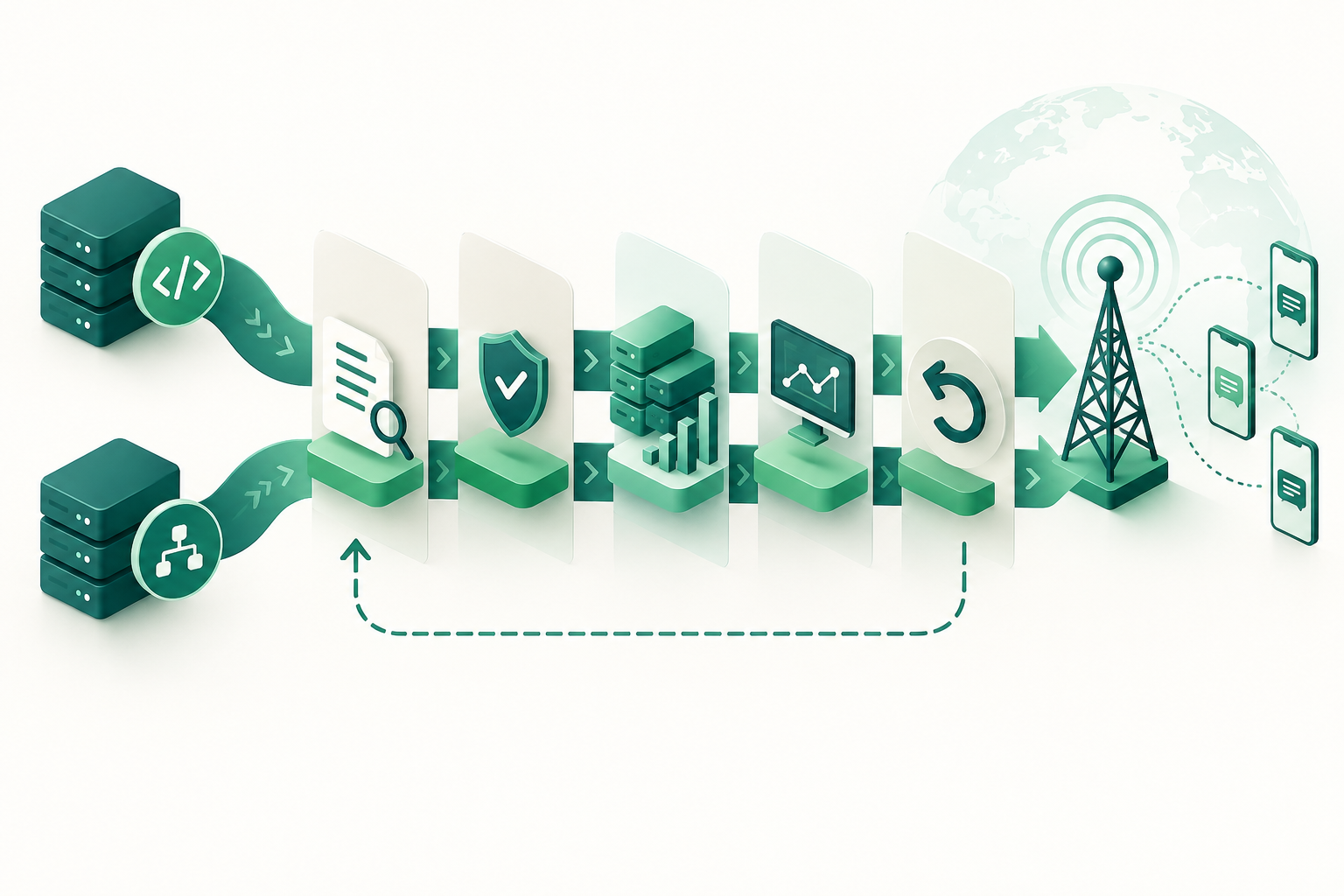
What Counts as a Configuration Change
A configuration change alters how an application or platform establishes or uses a connection, even when the application code itself does not change. It may affect HTTP interface parameters or an SMPP connection; the specific scope depends on the implementation and the technical agreement with each counterpart.
SMPP is an application-layer protocol that runs over TCP/IP and is used to exchange SMS messages. That description alone does not determine which parameters each system can change or how to deploy those changes. For HTTP and SMPP, confirm the meaning and constraints of each parameter in the applicable technical documentation.
This guide covers change control: what to review beforehand, how to limit exposure, and what to record. It does not replace regression testing of a complete integration or describe session maintenance or credential rotation.
- Identify the component being changed and the affected connection.
- Distinguish local changes from changes that may require coordination with a provider or counterpart.
- Do not infer compatibility solely because a parameter is present in a configuration.
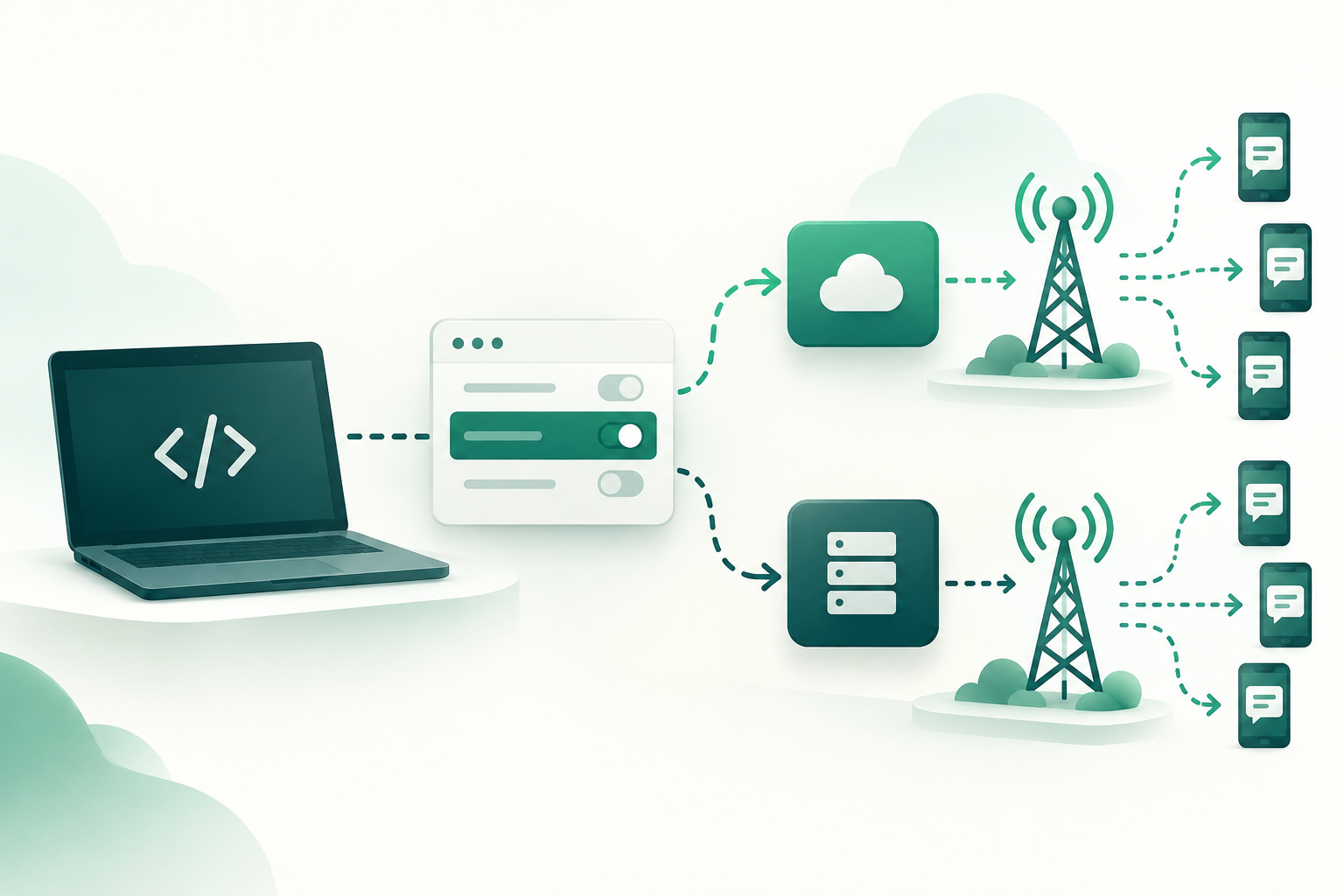
Preliminary Inventory: Scope and Dependencies
Before editing the configuration, create a change record that makes clear what is being modified, where it applies, and who must validate the result. The inventory should describe the current state and intended scope, rather than assume all connections share the same parameters.
Map each connection to the systems that use it, the teams responsible, and any counterparts that need to know about the change. If you cannot confidently identify the scope, pause preparation and complete the inventory before scheduling a production deployment.
- Record the affected parameter and component, its current value, and the proposed change in an access-controlled system.
- Note the applications, environments, and connections that may depend on it.
- Assign owners for deployment, monitoring, the decision to stop, and rollback.
- Indicate whether an external counterpart is involved and whether available documentation requires coordination.
- State the initial scope explicitly; avoid including unnecessary connections in the same change.

Impact and Compatibility Analysis
Classify the change by where it is configured and who controls the corresponding endpoint. A change contained within your own system may still affect dependent systems; if it alters an expectation shared with a provider, do not treat it as purely local.
Compare the new configuration with the technical documentation and agreements applicable to that connection. Available sources do not establish a universal list of compatible parameters for all HTTP or SMPP implementations: compatibility must be confirmed in the documentation of the parties involved.
If compatibility cannot be verified, reduce the scope or postpone the change. Do not use an isolated HTTP response or SMPP status as proof that the complete flow is working correctly.
- Is the parameter local, or does it affect a shared expectation?
- Is current documentation available for both ends of the connection?
- Which systems or processes could be affected if the connection no longer behaves as expected?
- Who must confirm compatibility before the change window?
- Which observations will help distinguish a change-related problem from an unrelated variation?
Plan the Deployment Before Applying the Change
Document the approvals required by your organization’s controls and prepare validation in an appropriate environment, if one is available. Define the change window, initial scope, person carrying out the change, and person deciding whether to continue or stop in advance.
A gradual deployment limits exposure by applying the change first to the narrowest representative and authorized scope. Do not assume every platform allows traffic or connections to be divided this way; confirm the actual deployment options in your architecture.
Specify stop conditions before starting. If there is no verifiable way to observe the result or return to a previous configuration, consider the change not ready for production.
- Record approvals, the change window, and owners.
- Validate the proposed configuration outside production scope where possible.
- Choose an initial scope that can be monitored and controlled.
- Agree which results allow the deployment to continue and which require it to stop.
- Confirm that the previous configuration is available for an authorized rollback.
Post-Change Checks: HTTP and SMPP
After applying the change, verify behavior from the affected system and connection using the checks documented for that implementation. Compare results with the pre-change baseline and record when each observation was made. There is no universal set of tests that can be claimed to apply to every HTTP API or SMPP implementation.
For HTTP, check that relevant requests receive the responses expected according to the interface documentation and that errors do not show an unexpected change. A successful response may indicate acceptance at one stage of the system; by itself, it does not prove that the SMS reached the device.
For SMPP, observe basic connection status and the expected exchange according to the counterpart’s documentation. Do not treat the existence of a session or a protocol response as proof of delivery to a mobile device.
- Review available logs and metrics for the modified component before and after the change.
- Check connection errors and interface responses using the meanings defined in the relevant documentation.
- If the system provides DLRs, record the reported status and its source; a DLR is not equivalent to verified receipt on the handset.
- Note the observation period and any differences from the baseline without automatically attributing causation.
Rollback Criteria and Exposure Control
Rollback should not be improvised during an incident. Before the change, define which conditions require stopping expansion, who makes the decision, and who restores the previous configuration. Triggers should be based on signals you can actually observe and operational limits agreed by your team; there is no universal numerical threshold here.
If degradation appears to coincide with the change, limit exposure and review the logs before concluding that the change is the cause. When an agreed trigger is met, stop the deployment and follow the approved procedure to restore the previous configuration. Then verify the connection state using the available checks.
Preserve evidence of the change and rollback. Do not delete logs or make additional adjustments during recovery without documenting them: doing so makes it harder to reconstruct the sequence and assess the outcome.
- Define observable triggers and the people responsible for stopping and rolling back.
- Set exposure limits that your platform can actually enforce.
- Keep the previous configuration accessible and verify that it corresponds to the affected component.
- After rollback, confirm behavior using the same checks used to assess the change.
- Record incidents and additional actions, even if the cause is not confirmed.
Final Record and Change Closure
When closing the change, leave a timeline that makes it possible to reconstruct what changed, when it changed, who applied it, and what was observed. Distinguish observed facts from interpretations: for example, an accepted response, a reported delivery status, and receipt on a handset are different claims.
If the change is rolled back, also record when it happened, why, and what checks were performed afterward. If the change is retained, document any outstanding actions and any limitations that prevent the result from being considered conclusive.
- Store the previous and new configurations in the authorized record-keeping system, without exposing secrets.
- Record the scope, affected connections, approvals, owners, and time of application.
- Record checks, incidents, the final decision, and follow-up changes.
- State clearly what is known, what was reported, and what could not be verified.
Frequently asked questions
Does an HTTP or SMPP configuration change require code changes?
Not necessarily. It may be limited to configuration, but can still affect connections and dependent systems. Review the scope and compatibility of the specific implementation.
Does a successful HTTP response confirm that the SMS reached the mobile device?
Not by itself. Depending on the interface semantics, it may indicate that a particular stage accepted the request. Receipt on the handset is a separate claim and requires appropriate evidence.
Does a DLR prove that the message was received on the device?
It should not automatically be treated as independent proof of receipt on a mobile device. Record the reported status and its source, and consult the definition applicable to the provider and route.
What threshold should trigger a rollback?
There is no universal threshold that applies to every platform and connection. Agree on observable triggers, exposure limits, and owners based on the available signals and your organization’s operational controls.
What should we do if compatibility is not documented?
Do not assume the change is safe. Ask the connection owners or relevant counterpart to confirm, reduce the scope, or postpone deployment until the risk can be assessed.
Sources consulted
- Acceso a la SMS API para SMPPVonage
- SMPP Protocol Specification v3.4, Issue 1.2SMPP Developers Forum
- HTTP Semantics (RFC 9110)IETF