E.164 Normalization for A2P SMS: Format, Validity, and Reachability
Learn what you can and cannot conclude when normalizing numbers for A2P SMS, and how to document decisions without confusing format, validity, and reachability.
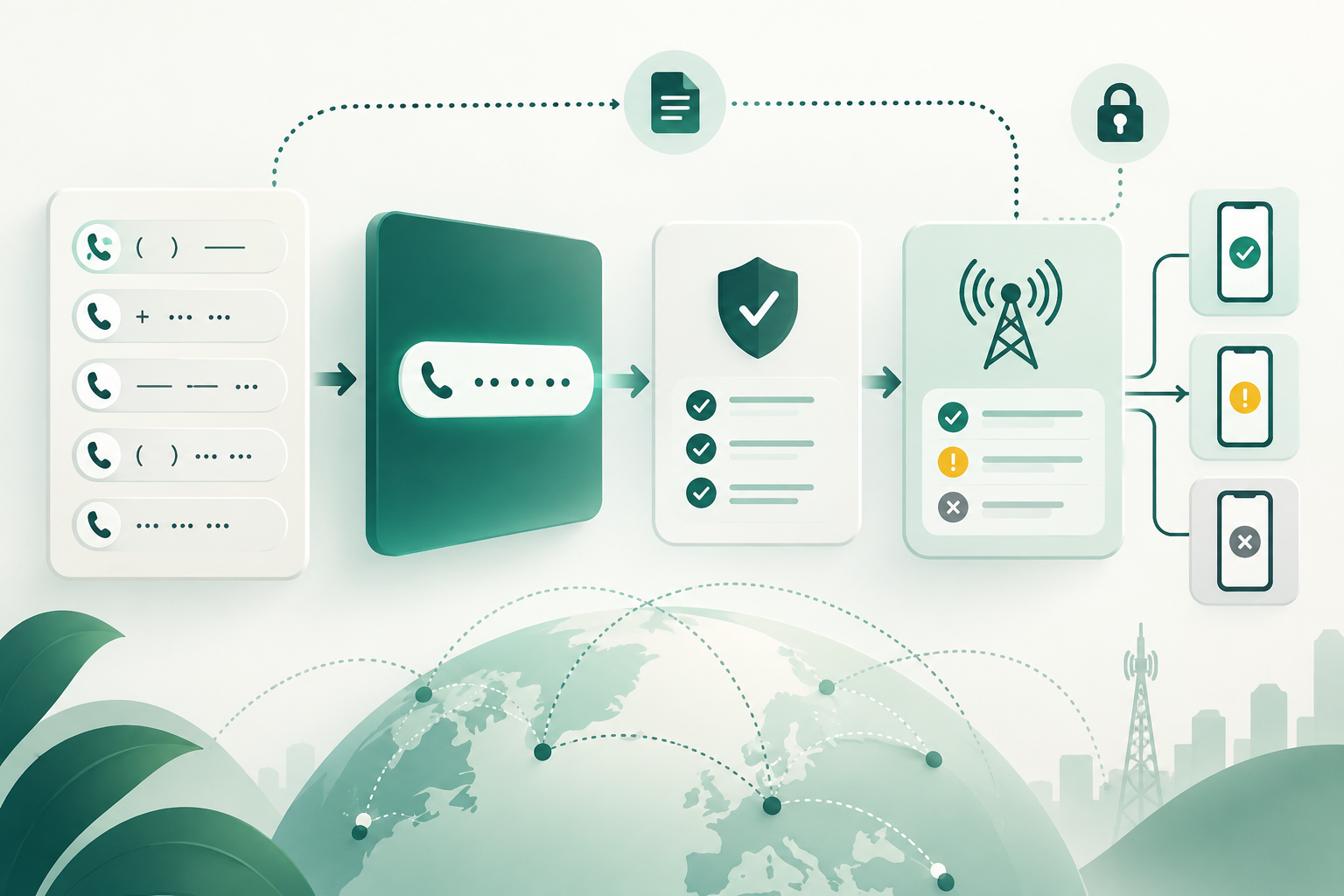
E.164 helps represent numbers uniformly; it does not prove they are valid
When working with numbers for A2P SMS, it helps to separate three questions: how a number is represented, whether it complies with the applicable rules, and what signals are available about its reachability. These are not interchangeable conclusions.
The ITU reference for Recommendation E.164 is available at https://www.itu.int/rec/T-REC-E.164/. Without verifiable excerpts from the recommendation, it would not be appropriate to attribute specific technical requirements to it here or turn it into a normalization recipe.
Based on the available documentation, an E.164 representation does not prove that a number exists, is assigned or active, belongs to the recipient, or can receive SMS. Before establishing controls, consult the relevant primary documentation and record what each check allows you to conclude.
- Format: Document the representation your system uses and the source supporting its rules.
- Validity: Determine which official documentation or numbering plan applies to the country and context.
- Reachability: Describe the signals observed and their limitations separately; do not present them as a delivery guarantee.

Design the workflow to preserve the input and document every change
The available evidence does not support prescribing a universal technical workflow for interpreting and transforming inputs. As a data-control measure, preserve the value as received and keep the original input, processed representation, and decisions made separate.
Before automating transformations, identify the authorized documentation that applies to the context. If you cannot support a rule, do not turn it into a confirmed technical instruction: route the case for review according to your internal procedures.
- Preserve the input exactly as received, in accordance with applicable privacy and retention policies.
- Where relevant, record which documented rule was applied and what context was used.
- Do not infer a country or transform an input using unverified rules.

International prefixes and national trunk prefixes require context
The supplied documentation does not include official plans that would support rules for international prefixes, country codes, or leading zeros. These cases should be resolved by consulting the relevant official numbering plan, not by applying a universal rule inferred from how the string looks.
If context is missing or the applicable documentation is unavailable, leave the input unchanged and flag the case for review under your internal process.
- Do not assign a country to an ambiguous input without context and documentary support.
- Do not generally remove or retain leading zeros without a relevant official source.
- Do not consider a string valid solely because it looks international.
Extensions and ambiguous inputs: do not turn them into subscriber digits
The available evidence does not establish a technical rule for handling extensions when normalizing numbers for SMS. Consult relevant documentation before deciding how to represent or separate them.
For separators, incomplete fields, or inputs with several possible components, distinguish what you received from any later interpretation. If you cannot justify an interpretation with documentation and context, do not present it as certain.
- Do not document an extension transformation as a verified rule without relevant technical support.
- Keep ambiguous inputs identifiable so they are not confused with confirmed data.
- Subject correction, rejection, or review rules to approved documentation and procedures.
Validate against official numbering plans and make limitations clear
The supplied documentation does not include official numbering plans or a verifiable procedure for checking numbers against them. To define these controls, consult the applicable primary source and record its scope. The ITU E.164 page is a starting point, not sufficient evidence for operational details: https://www.itu.int/rec/T-REC-E.164/.
Separate the result of a format check from any conclusion about existence, activity, ownership, or SMS reception. The available evidence also does not support treating an HLR query or network status as proof of consent, identity, ownership, or guaranteed delivery.
- Identify the plan, version, and procedure supporting validation before applying it.
- Describe check results without extending them beyond what they support.
- Keep consent requirements and applicable regulations separate from format or network checks.
Errors that undermine data quality
Without relevant documentation, removing digits, assigning country codes, or replacing original values cannot be supported as confirmed rules. Document the source for each transformation and preserve the input so you can distinguish received data from processed data.
A format check also cannot establish that a number is reachable. Decisions about A2P messages must comply with consent requirements and applicable regulations.
- Do not modify leading zeros without applicable documentation.
- Do not fill in country codes based only on a number's length or appearance.
- Do not equate an E.164 representation with a number that is assigned, active, or able to receive SMS.
- Do not present a transformation as verified if it lacks documentary support.
Traceability with data protection
The available evidence does not establish a technical traceability model or retention periods. Define access, logging, and deletion in accordance with applicable privacy policies and obligations, without attributing these decisions to sources that do not document them.
When documenting the process, distinguish the original input from resulting values and review decisions, while following relevant policies for handling phone numbers.
- Apply relevant access and retention policies.
- Base retention and deletion on applicable obligations and policies.
- Do not claim that a logging design is supported by official sources unless you have verified that support.
Frequently asked questions
Does an E.164-formatted number guarantee that it will receive an SMS?
No. The available evidence does not allow you to conclude that the format proves a number exists, is active, belongs to the recipient, or can receive SMS.
Should I always remove the leading zero?
The available documentation does not establish a general rule. Consult the relevant official numbering plan before deciding how to handle it.
What should I do with a number that does not include a country code?
Do not infer the country without context and documentation supporting that decision. If you cannot determine it, keep the input identified for review under your internal process.
How should I handle an extension when normalizing a number for SMS?
The available evidence does not establish a technical rule. Consult relevant documentation, and do not present a transformation as verified without supporting evidence.
Does an HLR query confirm the recipient's identity or consent?
It should not be treated as proof of identity, ownership, or consent, or as a delivery guarantee.
Sources consulted
- ITU-T Recommendation E.164International Telecommunication Union
- 3GPP specifications by series3GPP
- GSMA network technologies resourcesGSMA