Prioritizing A2P SMS Traffic When Capacity Degrades
An operational guide to distinguishing OTPs, alerts, and notifications, assigning internal priorities, and managing congestion without confusing priority with guaranteed delivery.

Why a shared queue can harm critical flows
When messages for different purposes share a queue and the same sending limit, a spike in non-urgent traffic can consume resources that time-sensitive messages also need. Separating flows can help control how messages are admitted and processed in systems managed by your organization.
This separation is an operational decision, not a guarantee of precedence across the entire route. The route, intermediate systems, and mobile network may apply their own controls. An internal priority does not ensure that a message arrives first or is received on the handset.
- Identify where a shared queue exists: the application, messaging platform, provider connection, or other components under your control.
- Record the limits and policies configured at each stage, and note which depend on third parties.
- Do not promise product or business teams end-to-end priority delivery unless it has been demonstrated and agreed for the route in use.
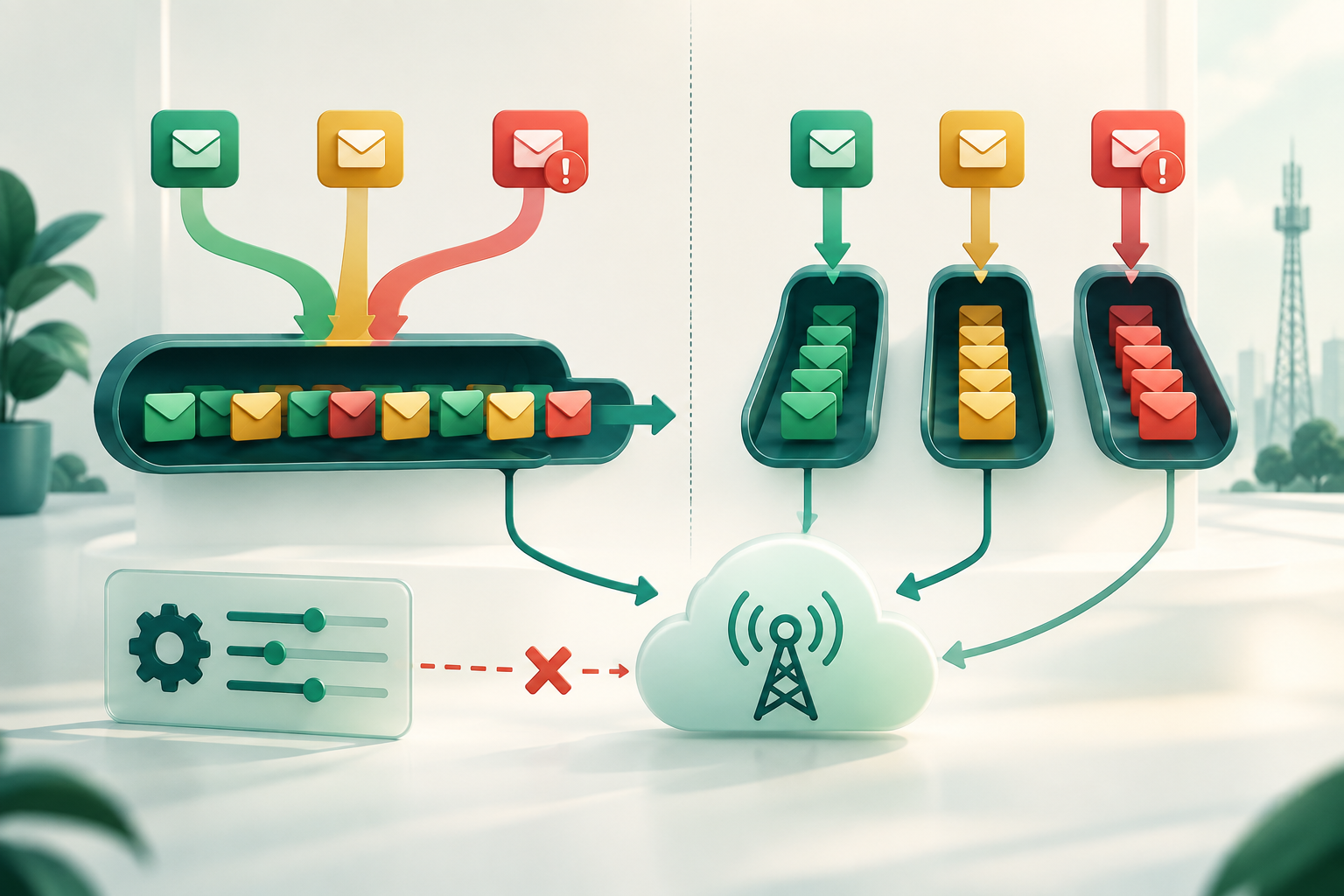
Purpose, criticality, and operational priority are not the same
Purpose describes why a message is sent: for example, to authenticate an operation with an OTP, report an alert, or send a transactional notification. Criticality expresses the impact on the user if the message is delayed or does not arrive in time. Operational priority determines how that flow is handled within systems controlled by the sender.
These dimensions should not be confused with a regulatory classification. Internal classification helps manage capacity; by itself, it does not determine whether a message is permitted, whether valid consent exists, or which legal requirements apply. Check those obligations separately for each case and jurisdiction.
- Label each flow according to its actual purpose and avoid vague categories such as “urgent” without a verifiable definition.
- Assess criticality based on the impact of delay, the message’s useful time window, and the possibility of completing the operation through another channel.
- Keep consent, content, and compliance checks separate from operational priority.

Define service classes using verifiable criteria
A service class is useful only if its rules can be explained and measured. Instead of assigning priorities by intuition, agree on criteria with operations, product, and service owners: user impact, functional expiry, expected volume, and recovery options.
For example, an OTP may no longer be useful after the authentication challenge expires. An alert may need prompt attention, although its urgency depends on the event. An informational notification may allow for deferral. These are examples for designing an internal policy, not a universal classification or regulatory recommendation.
- Document the purpose of each class and which services may belong to it.
- Define what it means for a message to have expired from the application’s perspective; do not assume that this time limit automatically applies to every component along the route.
- Determine whether a delayed message still provides value or should be cancelled, replaced, or handled through an alternative process.
- Specify who can authorize exceptions and how they are reviewed.
Isolate queues and control capacity consumption
Isolation can reduce direct competition between flows within components managed by your team. The specific implementation depends on the available architecture: do not assume that a connection, interface, or provider offers separate queues or effective priorities without checking.
Set per-flow limits and reserve or share capacity in line with the agreements and technical controls actually available. A poorly designed limit can also leave capacity idle or block important traffic, so validate it with your own data and review it under both normal and degraded conditions.
- Separate queues by purpose or class only when the system lets you control their admission and processing.
- Limit the volume of deferrable flows so a spike does not displace other traffic without control.
- Ensure that limits reflect the known effective capacity at each stage; do not assume that locally configured capacity is equivalent to what the network will accept.
- Document what happens to queued messages when capacity recovers.
Define admission, deferral, and discard rules before congestion
When load exceeds available capacity, the system needs explicit rules for deciding what to admit, what to hold, and what not to resend. Without an agreed policy, different components may accumulate messages, repeat attempts, or retain traffic that has already lost its usefulness.
Rules should align with functional expiry, actual platform limits, and applicable obligations. Discarding messages should be deliberate and observable; it should not be presented as an automatic solution for every case.
- Specify which classes may be deferred and under what conditions new messages will no longer be admitted.
- Define when to cancel expired or duplicate messages and how to report the outcome to the originating application.
- Avoid building up queues whose age exceeds the content’s useful time window.
- Record rejection, deferral, and discard decisions with an identifiable reason for analysis.
Coordinate priorities with TPS, backpressure, and retries
Internal priority must work alongside throughput limits, load-control signals, and existing retry policies. Do not indiscriminately increase sending rates or repeat requests in an attempt to catch up on delays: depending on the behavior of the application and the components involved, this could amplify the load or create duplicates.
Check the documentation for each interface to understand which responses, limits, and control mechanisms are available. The technical evidence available here does not support claims about universal behavior for SMPP fields, TPS, expiry, or delivery statuses; configure each integration according to its current contractual and technical documentation.
- Set sending limits per connection or destination only when they are confirmed for the specific integration.
- Align retries with observed responses, message expiry, and duplicate protection.
- Respect the backpressure signals exposed by each component; do not replace them with an automatic throughput increase.
- Test changes in a controlled environment before applying them to production traffic.
Measure each class without confusing acceptance, DLRs, and receipt
Acceptance of a request by an interface indicates an outcome at that point in the route; by itself, it does not mean the message was received on the handset. A DLR is a status report whose meaning and consistency depend on the route and integration. Do not present it as independent proof that a person saw the message.
Analyze indicators by class and destination when that data is available and comparable. Interpret latency, availability, and delivery statuses alongside their definitions, measurement windows, and observation limits.
- Distinguish accepted requests, rejections, reported delivery statuses, and any available independent verification.
- Track the time between the request and subsequent events, stating which points in the route the measurement covers.
- Review pending, expired, duplicated, and retried messages by class.
- Do not compare metrics across routes or periods without checking that their definitions and sources are equivalent.
Test degradation and document recovery
A priority policy needs tests that reproduce risks relevant to your own architecture. Simulate high load, delays, rejections, and gradual recovery only in authorized environments and in a way that does not affect users or external networks.
Before activating a policy, agree on owners, criteria for entering and leaving degraded mode, exceptions, and rollback procedures. Keep a change log so you can explain which flows were limited and why.
- Test that deferrable traffic does not consume all controllable capacity when load increases.
- Verify that queued messages are not sent after they have lost their usefulness.
- Check how retries, duplicates, and notifications to source systems behave.
- Define who can change limits and priorities, who approves exceptions, and how the configuration is rolled back.
- Review results with operations, architecture, product, and compliance owners.
Frequently asked questions
Does prioritizing an OTP guarantee that it will arrive first?
No. An internally configured priority can only influence the components where it is applied and controlled. It does not demonstrate precedence across the whole route, receipt on the handset, or delivery within a specific timeframe.
Are OTPs, alerts, and notifications regulatory classes?
Do not assume so. In this guide, they are examples of messaging purposes that may help with designing operational classes. Regulatory and consent obligations must be assessed separately based on the content and applicable context.
Which metrics confirm that an SMS was received on a phone?
Request acceptance and a DLR should not automatically be treated as independent verification of receipt on the handset. Check what each status represents in the integration and communicate uncertainty clearly.
How should I choose a sending limit for each class?
There is no universal value supported here. Base the limit on the capacity actually confirmed for your platform and each integration, define how it behaves under backpressure, and validate the policy through controlled testing and your own data.
Should all deferred traffic be retried when capacity recovers?
Not necessarily. Before retrying, check whether the message is still useful, whether it has expired or already been processed, and which duplicate policy applies. Retries should follow the interface documentation and existing limits.
Sources consulted
- SMPP v3.4 Issue 1.2SMPP Developers Forum
- RFC 9110: HTTP SemanticsIETF
- 3GPP specifications by series3GPP
- ITU-T Recommendation E.164International Telecommunication Union
- GSMA networks resourcesGSMA