HTTP and SMPP Availability for A2P SMS: What to Measure and How to Interpret Failures
A general operational guide to distinguishing connectivity, interface responses, and subsequent A2P SMS statuses. Checks and interpretations should be verified against the contract and implementation of each interface.

Availability Does Not Mean Delivery
This is a general operational guide, not a normative specification. The checks and interpretations described should be verified against the contract, documentation, and implementation of each interface.
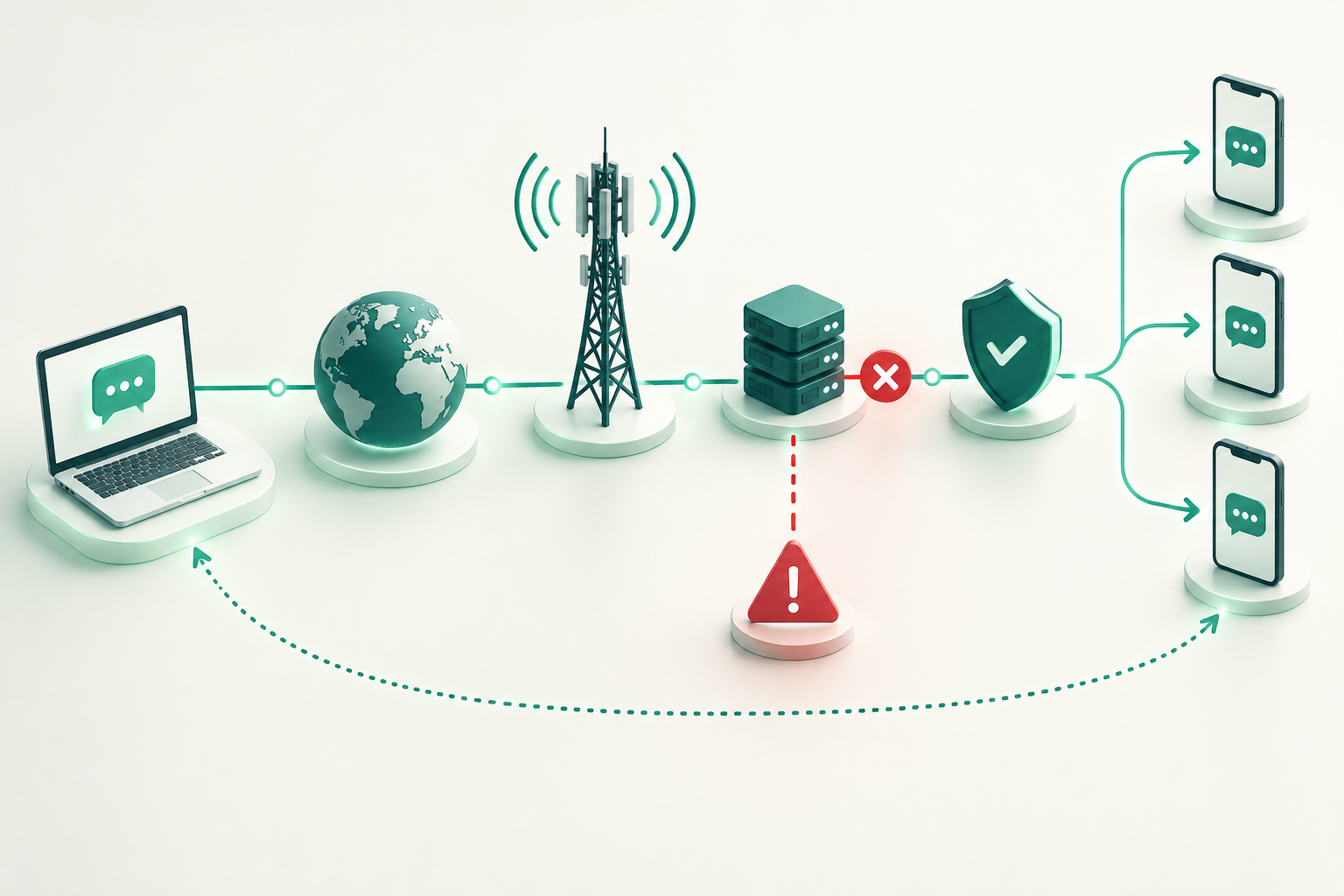
As a working framework, it is useful to distinguish three outcomes: connectivity, interface response, and the message’s subsequent status. A technical response alone does not establish that an SMS was processed, routed, or received on a phone.
Record each stage separately. If they are combined into a single “availability” metric, it may be difficult to distinguish a connection problem from a functional response or a subsequent outcome.
- Connectivity: Did the defined check to reach the service complete?
- Interface: Was a response received for the operation being checked?
- Subsequent status: What information about the message is available, and where did it come from?
- Do not treat an HTTP response, a response to an SMPP request, or an established session as sufficient proof of delivery.

Break the Check into Layers
As a suggested practice, identify the last completed stage before attributing a failure to the provider or the application. Where applicable to the implementation, a check can distinguish name resolution, network connectivity, communication establishment, authentication, operation submission, and interface response.
Define in advance which endpoint, test credentials, operation, and result count as valid. Compare the check with a known reference and retain timestamps and logs from both ends when available. A timeout means the check did not finish within the configured limit; by itself, it does not identify the cause.
During an incident, check whether the pattern affects all connections or only one client, endpoint, operation, or test destination. This comparison can guide the investigation, but does not by itself confirm where the problem originated.
- Record the exact stage of failure, according to the steps applicable to the interface.
- Use defined time limits and record elapsed time; do not present a timeout as a causal diagnosis.
- Retain the time, available correlation identifiers, and observed result; avoid storing credentials or unnecessary personal data.
What to Observe in HTTP
As a general operational practice, it may be useful to separate connection time from the total time until a response is received. Record the HTTP status, observed timings, timeouts, and any application errors exposed by the interface. Interpret the result according to the API documentation and contract; this guide does not define the meaning of specific HTTP codes.
Distinguish a received response from a functional outcome. An HTTP response alone does not determine whether the operation was accepted, rejected, or left pending: consult the documented semantics for that interface.
Avoid blind retries when a timeout occurs after a request has been sent. If the interface does not reveal whether the operation was processed, a retry could duplicate it. Clarify with the provider how to check the outcome or retry safely.
- As suggested indicators, record connection, response time, HTTP status, and the functional result reported by the API separately.
- Classify results according to the interface contract, without assuming a status has the same meaning in every system.
- Consult the API documentation to interpret responses and resolve uncertain outcomes before automating retries.
What to Observe in SMPP
As a general operational record, it may be useful to note the bind result, observed session status, configured activity checks, submit_sm requests and their responses, as well as disconnects and reconnects. The interpretation of these events depends on the version, configuration, and documentation agreed with the remote endpoint.
Do not infer delivery to the recipient from a response to a submission request. Similarly, an established session does not by itself prove that all future requests will be accepted or that their messages will have a particular subsequent outcome.
When available, correlate submission responses with the identifiers returned by the interface and with subsequent statuses. Treat a DLR as a status reported by the relevant system, not as independent verification that the phone displayed the message or that the person read it.
- As suggested operational observations, record established or lost sessions, duration, configured activity, and reconnects.
- Note the result of each submission request and its associated identifiers; keep the submission response separate from subsequent status.
- Consult the agreed configuration and documentation to interpret events, limits, and statuses; do not assume universal values.
Design Safe and Useful Synthetic Tests
As a suggested practice, a synthetic test checks a limited flow under controlled conditions; it does not automatically represent all traffic, destinations, or operators. Specify which component it evaluates and which conclusions are outside its scope.
Use controlled and authorized test accounts, numbers, and destinations, together with permitted and agreed content. Coordinate the method, frequency, and limits with the provider and applicable policies. If there is no controlled destination or clear authorization, limit the test to checks that are authorized.
Maintain an agreed frequency to avoid unnecessary traffic or interference. Identify the checks so their results can be separated from real traffic. Do not send messages to people who have not authorized the test.
- Define what the test is intended to check: connectivity, authentication, interface response, or an authorized test flow.
- Agree in advance on destinations, content, frequency, volume, and how tests will be identified.
- Document the limits: a successful result for one destination at one point in time does not guarantee general availability or future outcomes.
Relate Connectivity, Responses, and Subsequent Statuses
As a suggested investigation method, follow a sequence of evidence: check whether connectivity was established, whether authentication and the request completed, and finally which subsequent statuses are available. This sequence helps organize the investigation but does not by itself prove the cause.
Correlate timestamps, request or message identifiers, endpoint or session, received response, and disconnection events. Compare sender and receiver data when both parties can provide it. If common identifiers are missing or clocks cannot be compared, note this as a limitation.
Do not attribute a change in subsequent statuses to connectivity merely because it coincides with an increase in errors. Correlation can guide diagnosis, but evidence from the relevant stage is needed to establish a cause.
- Connectivity: record failures observed during the defined checks.
- Interface response: record what the response indicates under the agreed contract.
- Subsequent status: note available statuses or reports, together with their source and limitations.
- Keep records for each category separate instead of combining them into a single failure rate.
Indicators and Observation Windows
As a suggested practice, choose indicators tied to operational decisions: the proportion of completed checks, responses received within the configured limit, observed sessions, submission responses, and available subsequent statuses. Specify the denominator, population, check method, and data source.
Do not rely on averages alone. An average can hide brief interruptions or differences between endpoints and destinations. Preserve the time series and review relevant individual events without assuming universal thresholds.
Define observation windows and alert limits according to the service and operational agreements. Record configuration changes and maintenance to help interpret variations. If a synthetic test runs infrequently, keep in mind that it may not detect failures between checks.
- Report connectivity, interface responses, and subsequent statuses separately.
- For each indicator, state the time window, measured population, and number of observations.
- Review brief events and results by endpoint or session, in addition to the aggregate value.
Alerts and Evidence-Based Escalation
As a suggested practice, an alert can identify which check failed, where and when it failed, and for how long, as well as which preceding stages did complete. Set escalation rules according to observed impact and agreed procedures; this guide does not propose universal thresholds.
Before escalating, gather relevant records: timestamps, endpoint or session, operation, observed result, available correlation identifiers, and impact scope. Include the check method and completed steps. Do not include passwords, tokens, or unnecessary personal data.
When reporting to the provider or internal team, distinguish facts from hypotheses. For example, state that no response was received within the configured limit and identify the stage where this happened; do not claim the provider is down if the cause has not been isolated.
- Escalate according to agreed operational criteria and observed impact.
- Include evidence about affected and unaffected connections to help narrow the scope.
- If connectivity and the interface respond but the message status is uncertain, ask how to interpret the status and what records are available from the subsequent stage.
Frequently asked questions
Does an HTTP response confirm that the SMS was delivered?
Not by itself. It confirms that a response was received from the endpoint. The operation’s meaning and subsequent statuses should be checked in that API’s documentation and contract.
Does a successful response to submit_sm mean the recipient received the message?
That cannot be concluded from the response alone. Consult the interface documentation and available subsequent statuses, taking their source and scope into account.
Does an established SMPP session prove end-to-end availability?
No. It reports only the observed session; it does not by itself prove that every request will be processed or that messages will have a particular subsequent outcome.
What should a synthetic test do when there is no controlled destination?
Limit itself to authorized connectivity and interface-response checks. Do not send messages to recipients without authorization or infer a subsequent outcome from a partial check.
What information should be shared when escalating an incident?
Include the time, endpoint or session, operation, failure stage, observed result, available identifiers, and scope. Separate facts from hypotheses and exclude unnecessary credentials and personal data.
Sources consulted
- HTTP Semantics (RFC 9110)IETF
- SMPP Protocol Specification v3.4SMPP Developers Forum
- SMPP specificationOVHcloud